Coin Values Moving with Precious Metals: Up-Dated 11/9/2026: Gold $4096 | Silver $52.13
1924 Nickel Value
An accurate 1924 nickel value requires identifying key details about the coin. Using the step-by-step process, first confirm the date, often semi-clear. Because of the premium values involved, the condition of the coin becomes important to judge. Additionally, identifying mintmarks further adds to a complete description. Compare your coin when referencing close-up images of these key features. Determine its narrow range on the value chart.
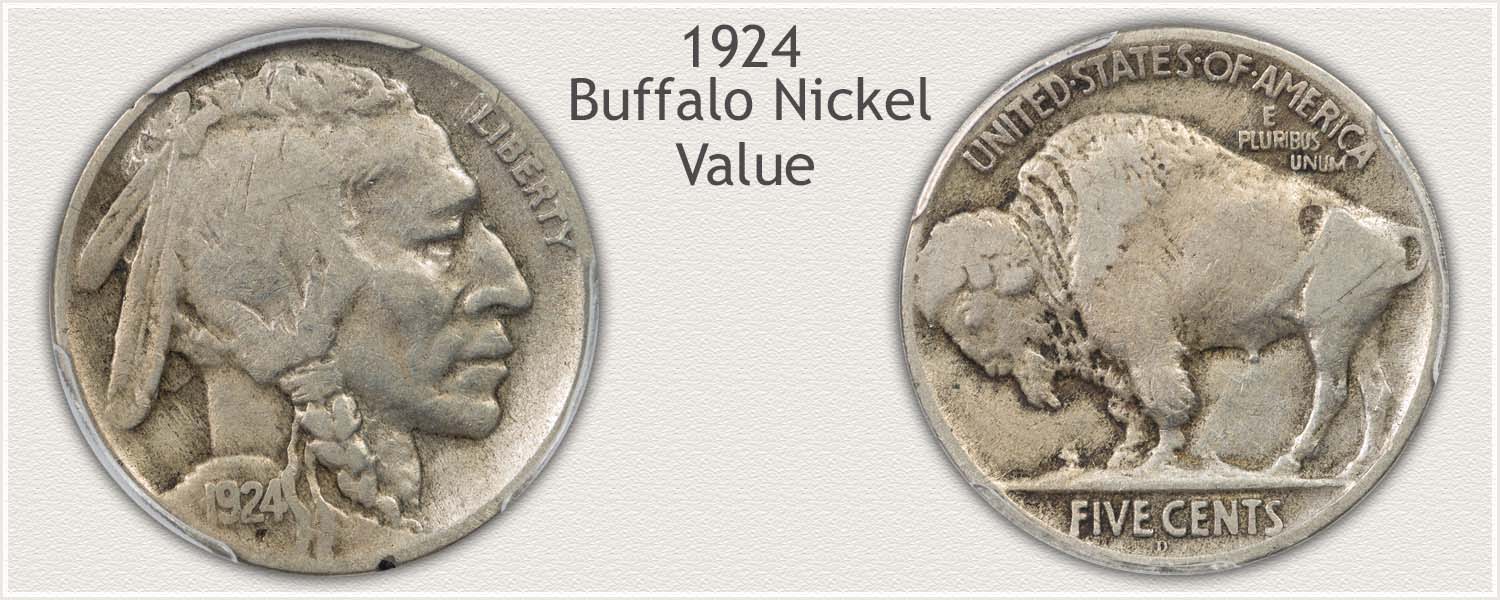 (fig. 1) Obverse and Reverse of a 1924 Buffalo Nickel
| 1924 Nickel Value | ||||
|---|---|---|---|---|
| Condition of Coin | ||||
| Date | Good | Fine | Extremely Fine |
Mint State |
| 1924 Nickel Value Updated | 2026 | |||
| 1924 | $1.20 | $3.14 | $18 | $121 |
| 1924 D | $6.72 | $22 | $147 | $585 |
| 1924 S | $12 | $59 | $395 | $2,672 |
There is a demand for these old nickels. The chart represents wholesale Buffalo nickel values. Computed from dealer's price lists with various markup factors figured in.
Steps Leading to Value:
- Step 1: Date and Mint Variety Identified: Verify both the date and mint issue, completing a key element of the coin's description.
- Step 2: Grading Condition: Judge condition when comparing with images of grade standards.
- Step 3: Special Qualities: How to Recognize a Premium San Francisco Mint Nickel.
Step 1: | Confirm the 1924 Date and Mintmark Combination
A noticeable wide range of values show on the above chart. Following are the steps to accurately identify both the date and the mint that struck these 1924 nickels. Looking closely at the shoulder area of the Indian, determine the date of the coin. Because of potential value, handle the coin by the edges, helping preserve the surface.
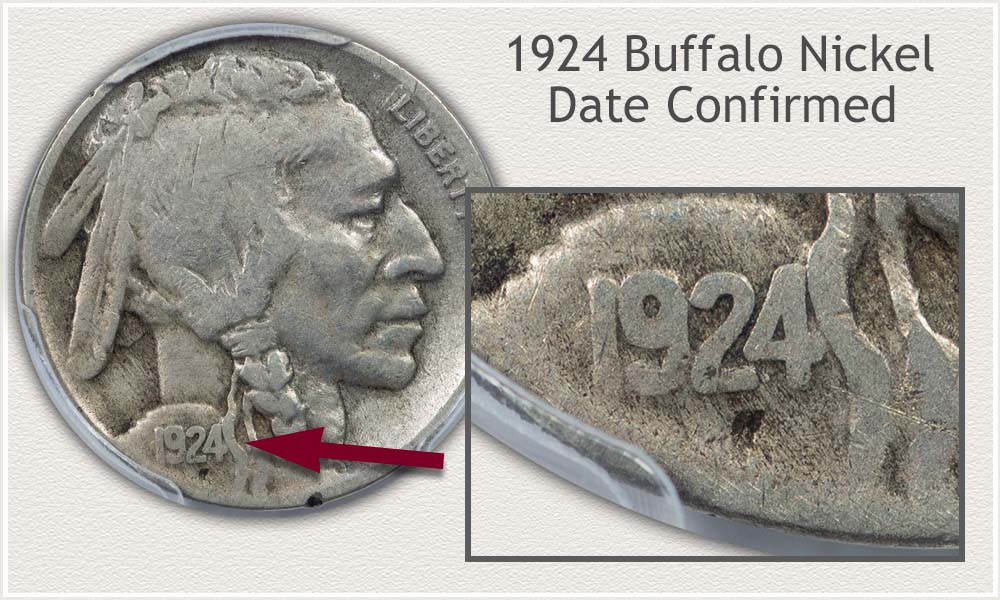 (fig. 2) Locate and Record the Date of the Buffalo Nickel
Techniques to Identify a Partial Date Buffalo Nickel
A semi-clear date is often what is left after wear has smoothed this area of the coin. Although parts of the date are missing, visible markers help decide the exact date. Inspect closely and compare your coin with the image (fig. 2). Faint traces of numbers lead to deciding on the date.
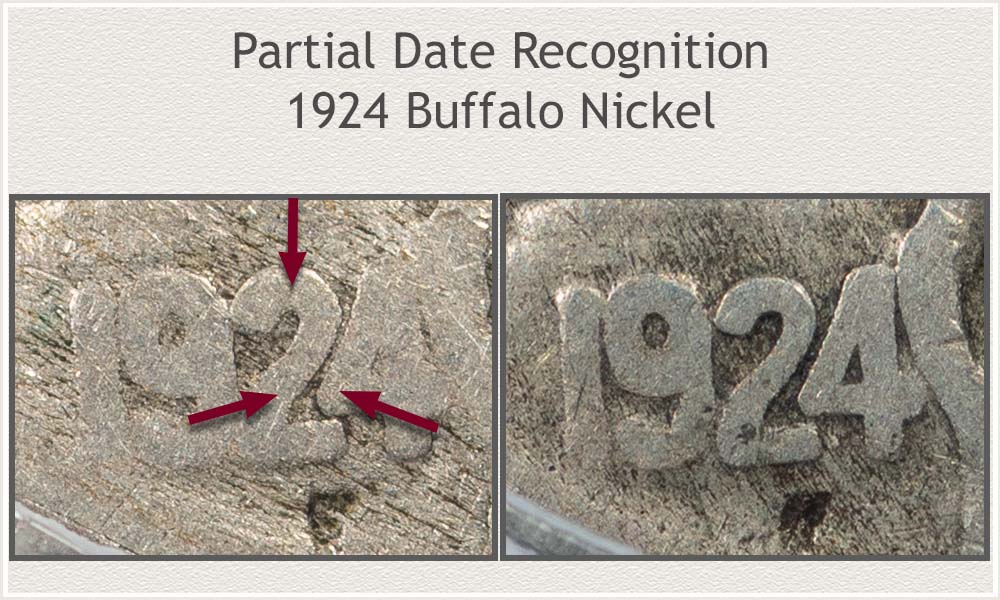 (fig. 3) Highlighted Features Identifying a 1924 Buffalo Nickel
With the high premiums placed on these nickels, this is a coin important to identify correctly. Most of the date in image (fig. 3) now shows only parts of the numerals. Fortunately, enough of the "2" and "4" remain for a confident decision. A critical marker as these numbers fade is the straight edges separating the "2" and "4." An angled shape of straight edges defines the "4" from the straight angle lines of the "2."
As wear progresses, often the "19" elements fade completely. The right side of the "4" merges and disappears into the Indian's shoulder. This continued wear leaves the inner curl of the "2" and the straight angle lines. A close comparison of your coin with these examples helps confirm the identity of the coin. After the date becomes known, the mint issuing a 1924 nickel contributes to finding an accurate value.
Three Issues of 1924 Nickels to Recognize
Recording the mint that struck the nickel further defines the coin. This date and mint combination determine how coins are listed on value charts. Production of nickels continued at three different mints in 1924. The two branch mints, one in San Francisco, used a small letter "S" mintmark. Denver, the other branch mint, placed a small "D" mintmark on its coinage. Philadelphia, the main mint, did not use mintmarks in 1924. Confirm a Philadelphia mint issue by the absence of a mintmark.
Looking at the reverse, mintmarks were located at the bottom of the design near the rim. Under the VE and CE of FIVE CENTS, these small letters often need magnification to correctly recognize. View the mintmark area under a single light, helping bring out detail.
High Demand "S" Mintmark Nickel
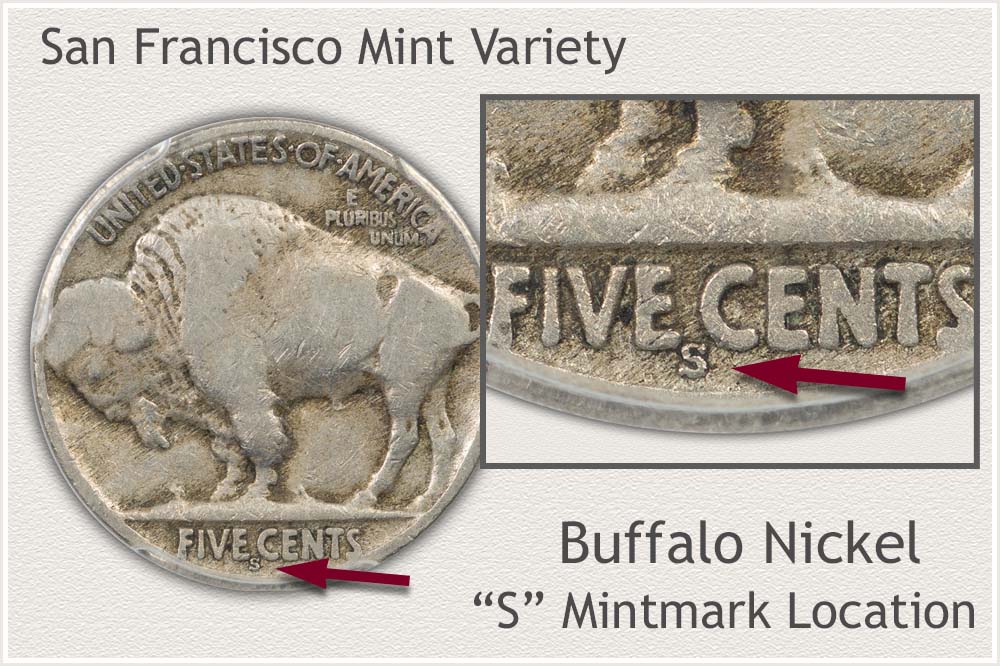 (fig. 4) S Mintmark and Location Highlighted on a 1924 Buffalo Nickel
1924 is another year the San Francisco Mint reduced its production of nickels. With a mintage of 1,437,000, this small number of coins became the fourth lowest issue of the entire series. At less than a million and a half struck, San Francisco 1924 nickels draw the attention of both collectors and the coin market.
Adding the low mintage total with popularity of the Buffalo series, demand for the coin results in the nice premiums listed on value charts. An elusive coin to find, inspect both the date and mintmark closely, confirming a valued collectible.
"D" Mintmark Nickel
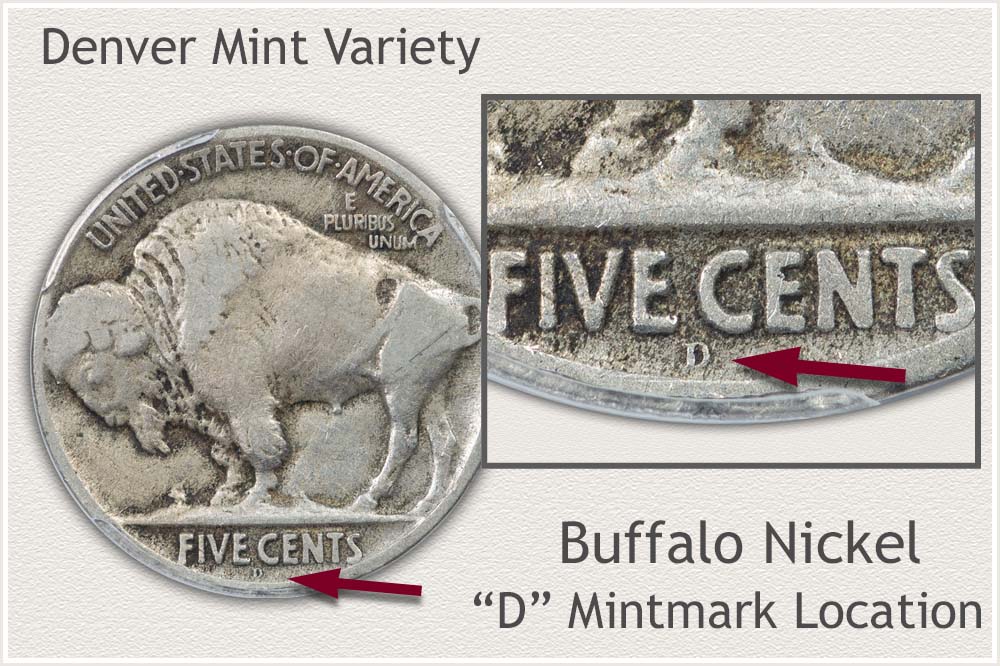 (fig. 5) D Mintmark and Location on Reverse of a 1924 Buffalo Nickel
The Denver Mint 1924 issue enjoys the attention of collectors. Within this one coin, both a low production mintage and scarcity in high condition show in the premiums listed on value charts. This is a year Denver struck only 5.2 million nickels, a below average number.
Viewing the chart, note the rise in values with the rise in condition of the coin. Any Denver 1924 nickel with strong portrait detail and facial features quickly finds an interested collector. First confirm the "D" mintmark and then judge condition as the next step.
Philadelphia "No" Mintmark Nickel
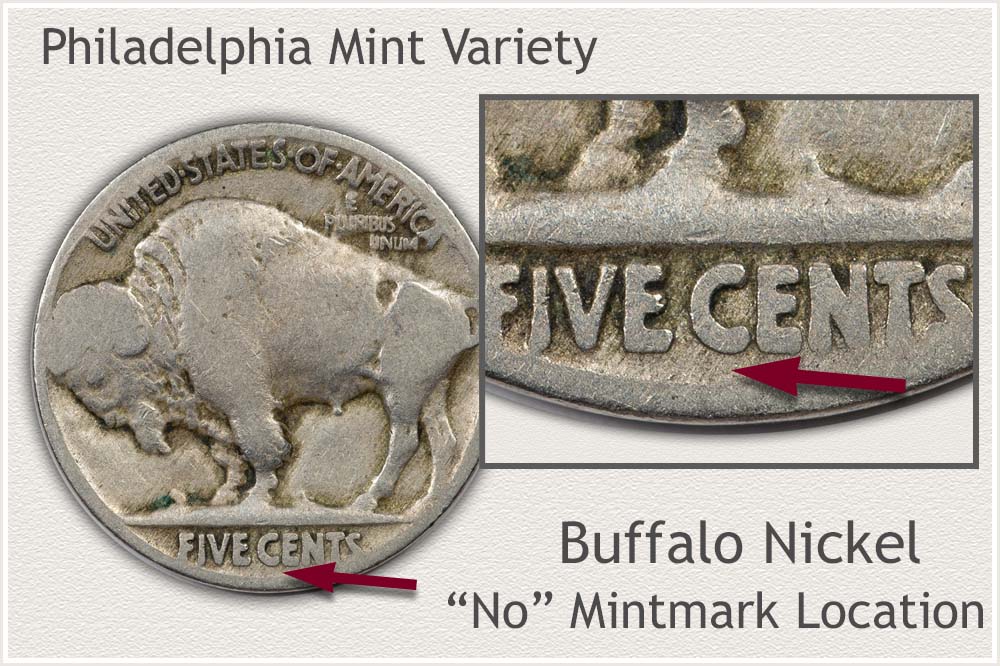 (fig. 6) No Mintmark Identifies the Philadelphia 1924 Buffalo Nickel
A 1924 Buffalo nickel finds a wide appeal with collectors. The Philadelphia Mint produced ample quantities of nickels, striking over 21.6 million pieces. These were made in ample quantities by the Philadelphia Mint, striking over 21.6 million pieces. Although original mintage numbers have a degree of indicating scarcity, market prices reflect both demand and supply of the coin.
With affordable premiums listed on the chart, a 1924 Philadelphia nickel appeals to many beginning collectors. An old Buffalo nickel from the 1920s, in highly detailed condition, finds a place in many sets of nickels. Confirm the highlighted area (fig. 6) does not have a mintmark. All Buffalo nickels without a mintmark were struck at the Philadelphia mint.
Condition of the coin now becomes important to its description. Record both the year and mint of the coin. This date and mint combination, along with an understanding of its condition, forms a detailed description.
Step 2: | Grading with Images Narrows Condition Range
1924 is already a premium coin within the Buffalo series. Now very old, its condition becomes the next focal point on the value chart.
Judging condition determines the coin's "grade," a hobby term used within an accurate description. These grades follow standard qualities of their key features. Using the images of example grades, find a close match with your coin. Wear on the surface presents in typical patterns. Descriptions of the grades define these visible patterns, indicating the grade level.
Use an approach of comparing your coin with the following coins of known grades. A close match identifies and narrows your coin's condition into a grade.
Mint State Grade
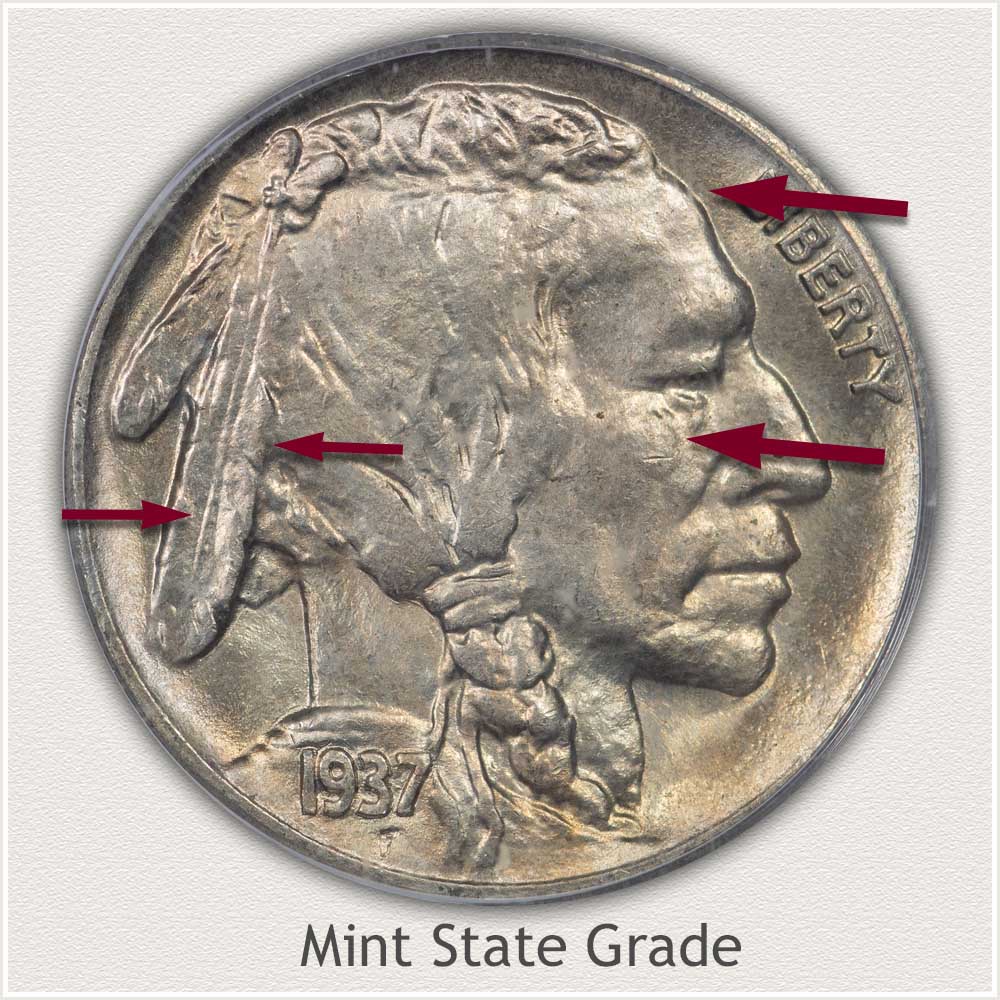 (fig. 7) Examine and Compare the Highlighted Areas on a Mint State Grade Buffalo Nickel
Buffalo nickels in Mint State condition remain without any wear on their surface. As a grading guide, the "no wear" description becomes a strict standard required for the grade. At this high level condition, luster and metal texture determine the coin's grade. The presence of original luster indicates no wear on the surface. Smooth and flattened metal indicates wear on the surface. Examine the Indian's forehead, cheek, and feathers, helping confirm the no wear condition.
Staring at the forehead, luster radiates from both high and low contours. Examine your coin under a single light to see this brilliance of luster. The fine texture on the surface reflects light, causing luster to shine with a brilliance. When tilting the coin, luster moves from high points to low areas. Deeper tones within low areas become brilliant with the changing light position. Any wear on the metal, even slight wear, removes original texture. This dulls the shine, creating a distinct smoothness on the surface.
Next, examine the cheek and surrounding area. Moving and tilting the coin, confirm a consistent luster and metal texture by comparing high and low reliefs. The Indian's cheek is an excellent area, giving clear indication of the absence of wear. Surface qualities of various contours, high and low, quickly indicate the coin's condition.
Inspecting small details of the feathers helps confirm the Mint State grade. Continue using the comparison of high and low areas for similarity. Examine all edges of the two feathers. Wear smooths these high points. Without wear, edges along the feather match both the shine and texture of the interior. These "no wear" qualities displayed in three high relief areas indicate the Mint State condition.
Extremely Fine Grade
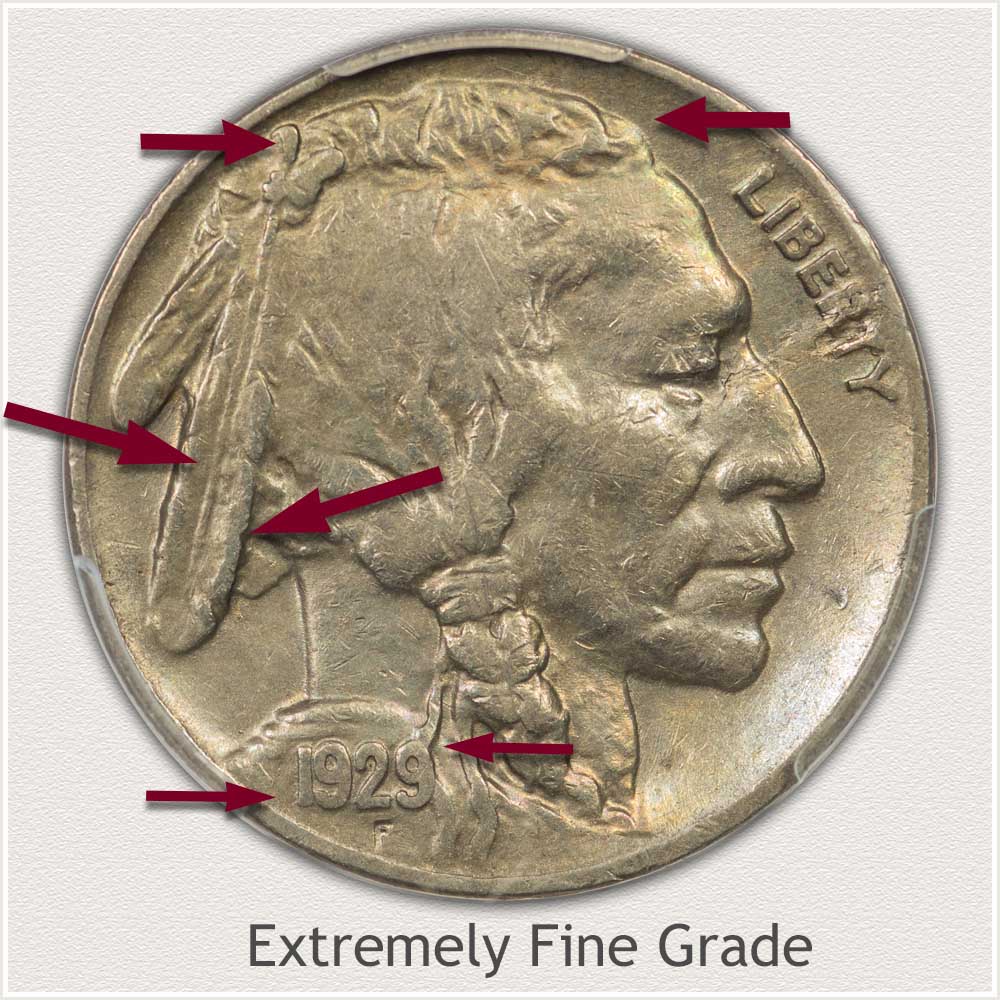 (fig. 8) Obverse Showing Grading Points on an Extremely Fine Grade Buffalo Nickel
Noticeable on the chart, demand for 1924 nickels in high quality supports large premiums. In the circulated category, collectors seek examples that display only light wear overall. As a grading term, light wear restricted to high points defines the Extremely Fine grade. Confirming this "light wear" category spots a valuable nickel. A visual match of your coin with the example performs an initial examination starting the grading process.
First, view the date and its surrounding area. This prime vocal point displays the date clearly and raised above the shoulder background. All numbers remain outlined with only a slight amount of weakness occasionally seen. Typically, complete outlines are the norm; however, a faded lower part of the One (first digit) still meets the grade level. Occasionally a soft strike when minting the coin causes a less bold first digit.
Feather details at the back of the Indian's head show only slight wear. Examine the large feather from the bow at the top to its end. A bold central shaft remains complete the full length. On both sides of the shaft, lower relief areas rise to a high contour edge defining the feather. The extent of visible wear slightly flattens the top edge of the feather. To recognize wear, note a sharp edge around the worn, flattened metal. Wear removes the soft roundness of contours. This edge becomes the visual indication of wear on the surface. In the illustration, examine the end of the feather to see this flat top worn surface.
As a grade indication, the hair strands at the top of his head show many strands and deep recesses. Above the part line, hair strands do not merge into large flattened areas. From the forehead to the braid, visible recesses define many waves and hair strands. Looking closely at your coin, confirm the worn surfaces remain separated without any widespread merging.
Overall, an Extremely Fine grade Buffalo nickel appears sharp and well detailed. Any wear does not distract from this bold impression of the coin.
Fine Grade
 (fig. 9) Compare to the Highlighted Features of a Fine Grade Buffalo Nickel
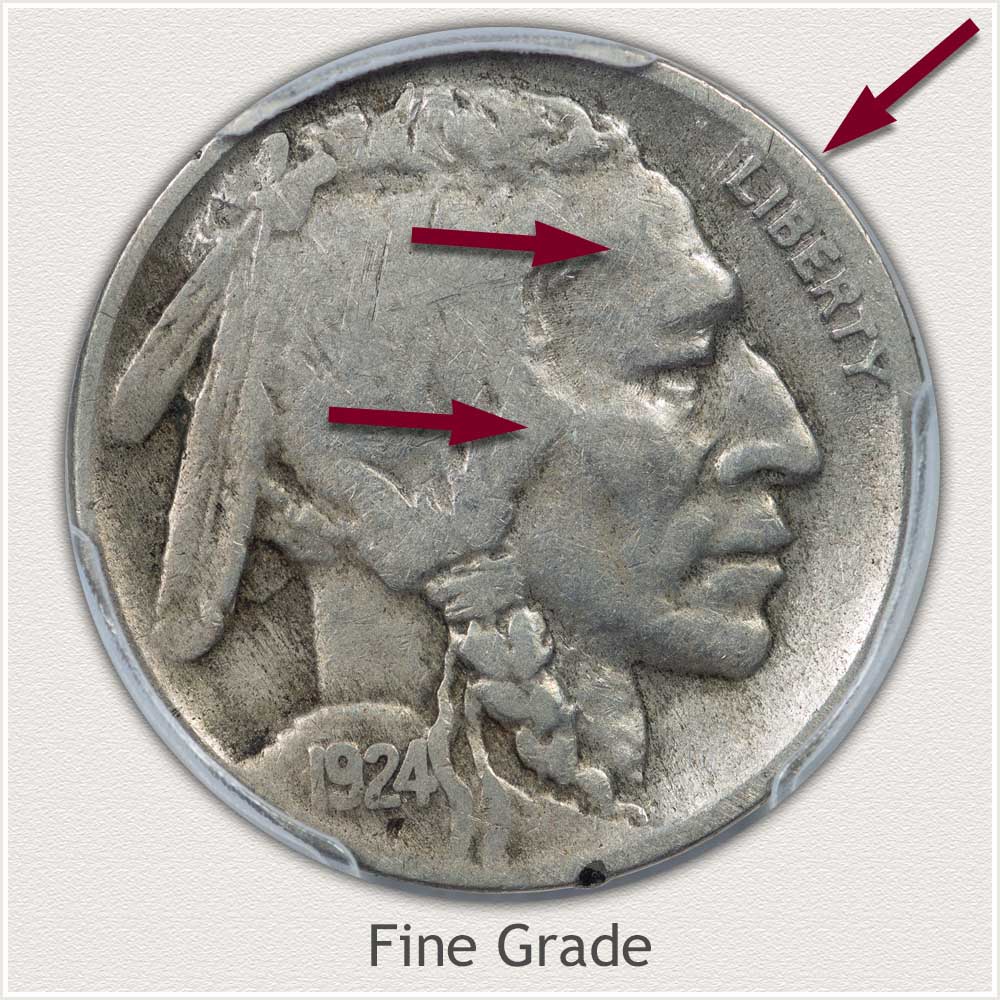
Clarity of design begins to really stand out on a Buffalo nickel in Fine grade condition. Defined as moderately worn, visibly bold facial features, date and lettering help recognize the grade. This example (fig 9) shows these three features nicely.
With a focus on the Indian, note the high contours of his cheek and eyebrow. Both areas remain with rounded contours across the top. The amount of flattened metal appears small, in contrast to the flatness within his hair.
Also notable are the clear letters of LIBERTY and numbers of the date. In the example, LIBERTY remains clear from top to bottom of the letters. A small amount of fading across the tops of the letters meets the grade level. The date also shows moderate wear; the numbers are worn flat and low in profile. It is the completeness of all numbers raising the condition into Fine grade range. With a close look, only a minimal amount of slight fading of number outlines shows along their edges. See the article below highlighting additional elements confirming the Fine grade.
Good Grade
 (fig. 10) Features of a Good Grade Buffalo Nickel
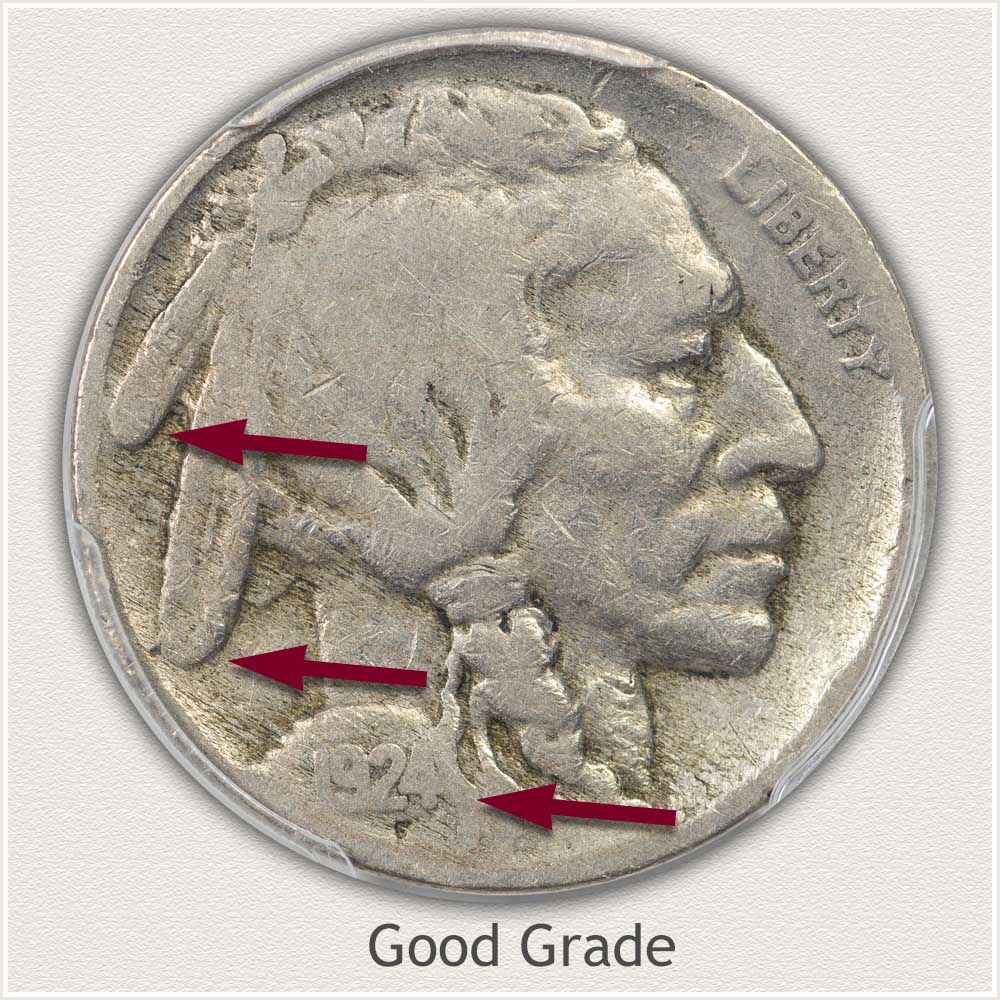
Because of its demand, a well worn 1924 nickel has value potential. Heavy wear on its surface and many areas of flattened metal define the Good grade condition. A typical Good grade Buffalo nickel displays a soft, faded appearance. A few key features highlighted on the example (fig. 10) point to key grading focal points.
First inspect the Indian's portrait. Required to meet standards, an entire outline of all features within the portrait remains bold above the field. Look closely at the feathers. Both ends of the features show separation from the rim. Additionally, the shoulder has a small definition along the outside, an indication of a slightly raised edge.
The date area on the example shows most of the outlines of each digit. A readable date is a key feature, with some fading of number outlines. Buffalo nickels with their bold, deep design, have a nice eye appeal, despite the amount of wear.
How to Video: Grading Buffalo Nickels
An in-demand date, 1924 nickels rise in value along side a rise in quality. Continue with images, video, and expanded descriptions highlighting important features that determine a grade.
Grading Buffalo Nickels | Visual Grading Guides
Step 3: | Special Qualities: Identifying the Value Rise from Good to Fine Grade
A 1924 nickel minted by the San Francisco mint has an unusual value profile. Note, it is worth a nice premium in heavily worn condition. The above chart also shows its value rises sharply when found in higher quality grades. Most other dates and mints show slower, lower percentage increases from one grade to the next.
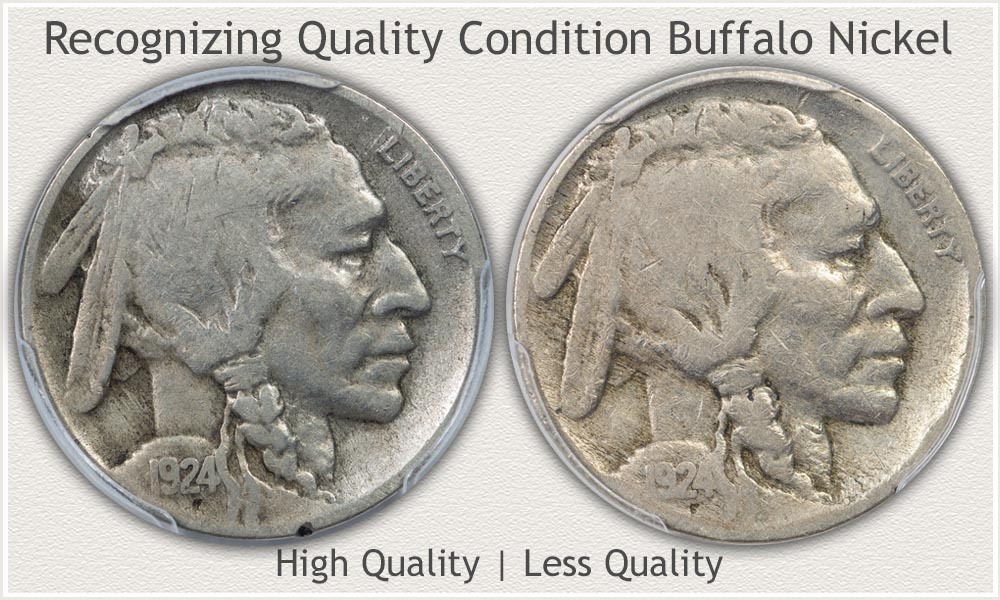
With all three issues of 1924 nickels, there is a strong value difference between Good to Fine grade. Judging condition becomes important. With an overall view, examine the two coins (fig 11). Compare the left coin in Fine grade to the Good grade coin on the right.
 (fig. 11) Subtle Qualities of Good and Fine Grade Buffalo Nickels
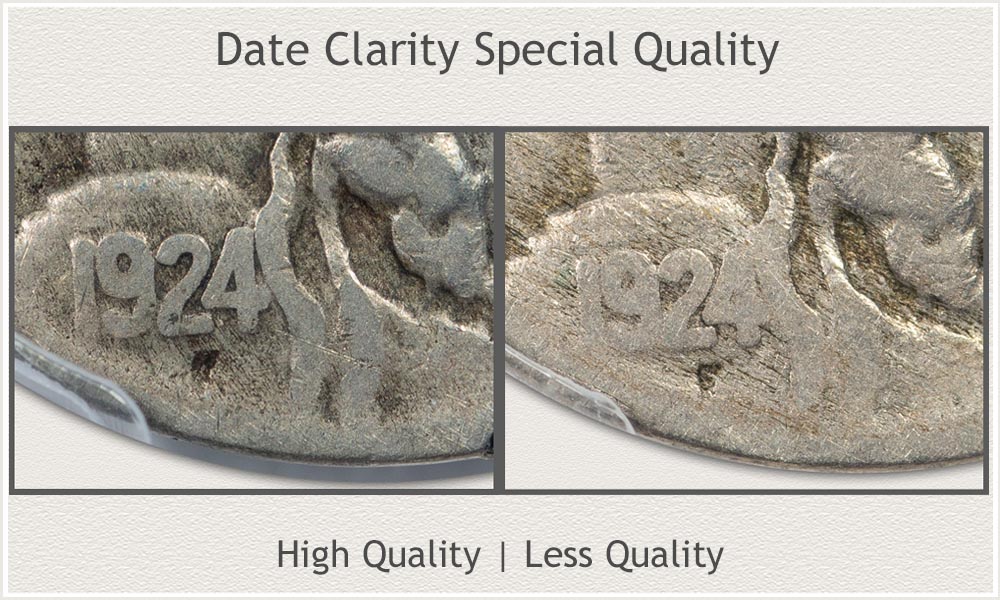
When compared side by side, subtle visual differences become more apparent. Look closely at three features on both coins (fig. 11). Small changes in clarity separate the higher grade from a lower quality condition.
 (fig. 12) Grading Features on Good and Fine Condition Buffalo Nickel
With a magnified view of the date (fig. 12), inspect the outlines of the numbers. A sharper clarity on the left coin, less clarity on the right. Both dates rise only slightly above the field. However, it is the completeness of the date's outline separating the two in quality. Distinct fading on the right coin, almost complete outlines on the left.
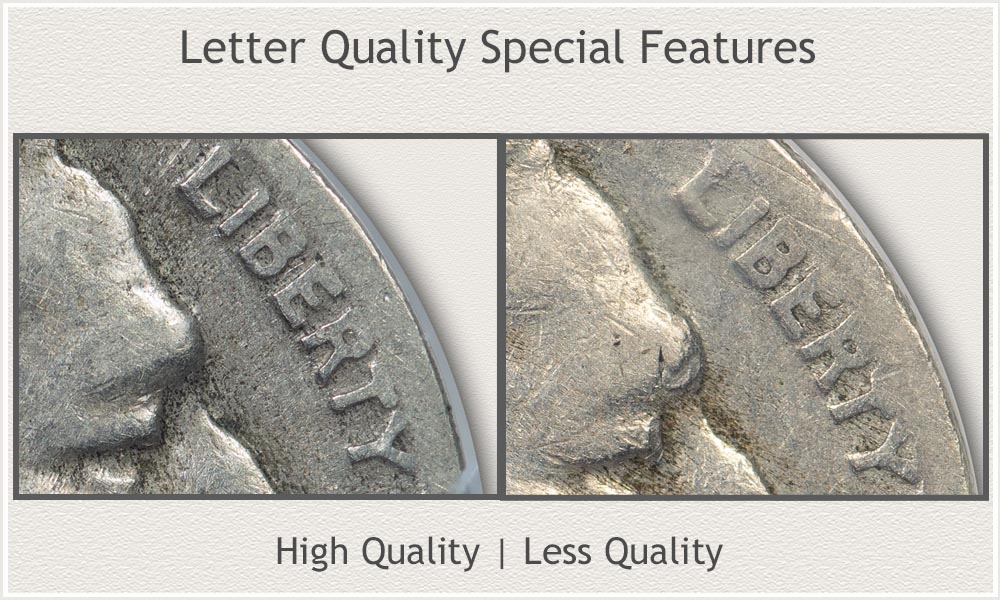 (fig. 13) Comparing Grades of Good to Fine Lettering
Lettering of LIBERTY placed along the rim sits almost as high above the field as the rim. Both the lettering and rim reduce in height as they wear. The visual difference between moderate and heavy wear shows when letters and rim wear to a level they connect. Scan along the tops of the letters. A subtle amount of detail remains on the left side coin, showing a separation of letters and rim.
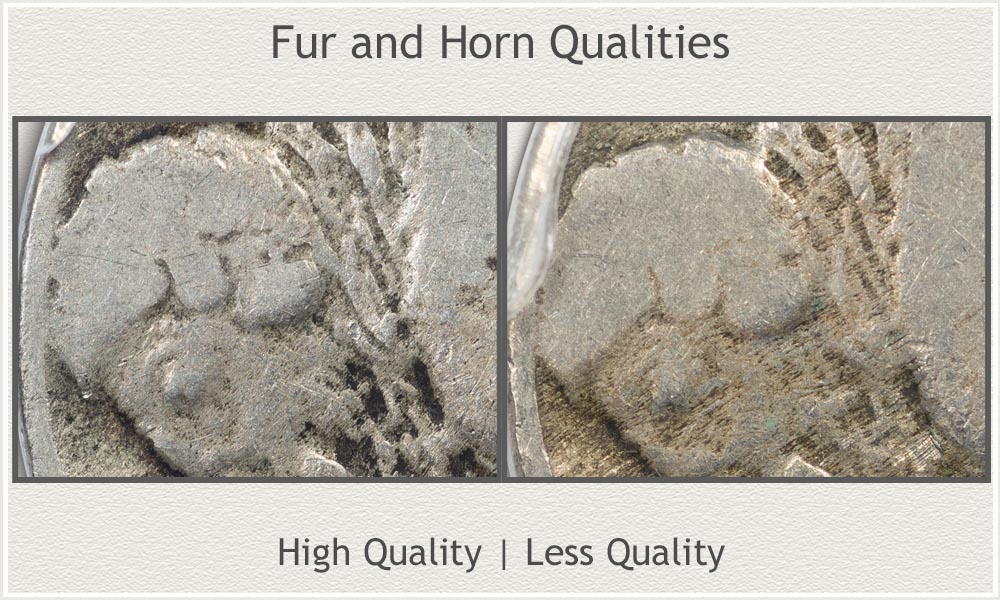 (fig. 14) Subtle Detail Qualities of Good and Fine Grade Buffalo Nickels
Inspect the reverse next. Rounding out an overall judgement, recognize the difference in detail showing on the buffalo's head. Along the top of the head, note more fur detail on the left coin. This left side coin displays a slight detail improvement compared to the coin on the right. Although both examples show a mostly smooth head area, the detail across the top and behind the horn becomes the visual separation feature.
Additionally, slightly more horn detail shows on the left side coin. Notice, above the eye, the base of the horn curves up and forward becoming narrow towards its end. Combined the extra fur and horn detail places the condition of one coin above the other.
These focal points, both obverse and reverse sides, fine tune a grading judgment. Visual quality comparison of your coin with the example images points to similarities with your coin.
References
U.S. Mint. (1925) Annual Report of the Director of the Mint Fiscal Year 1925. United States Government Printing Office.
The Bureau of the Mint. (1928) Catalogue of Coins of the United States. United States Government Printing Office.
🔎What's next: Review the following articles with insights for professional evaluation of high value nickels, storing and selling these premium nickels.
Coin Values | CoinStudy Articles
Date by Date
In Depth Buffalo Nickel Value
1913 to 1938
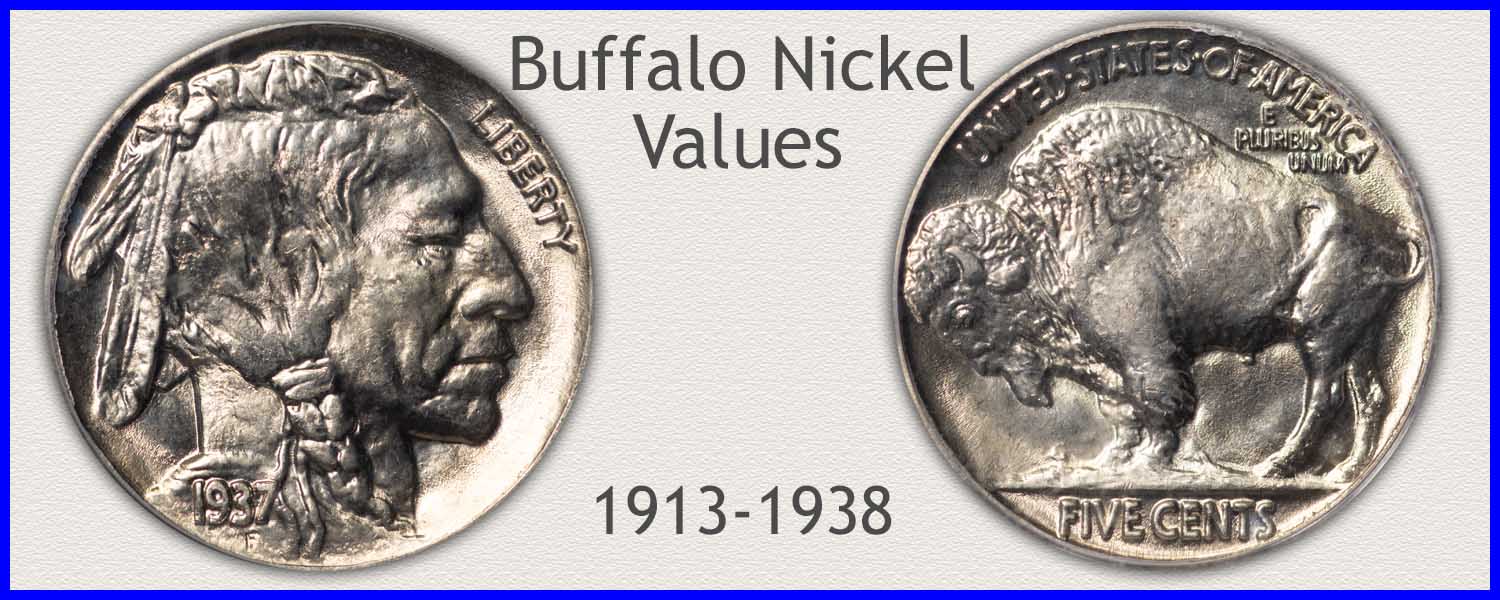
Buffalo Nickel Value | Complete Listing
Buffalo nickels enjoy popularity and demand from collectors. Even coins without dates have a premium value. Today, collectors closely examine Buffalo nickels, looking for special dates and higher condition examples. Often large value differences are found in just a minor improvement in how well the coin is preserved. This collector preference creates demand, showing in strong values on the complete value chart. Follow the steps to correctly identify and judge your old nickels.
Coin Grading Services | Professionally Evaluate Your Coin
A premium 1924 nickel often requires additional evaluation. Professionals at these coin grading services first authenticate the coin. Next a grade is established. Then the service encapsulates the coin. This combined gives premium value coins market acceptance of its condition and grade.
Safe Coin Storage | Recommendations
Recommendations on basic supplies that greatly improve coin storage. Providing for safe handling, preserving value, and organizing your box of old coins. Safely house and store old nickels and maintain their value into the future.
Selling Coins | How to Get the Best Value
Selling coins follows a defined method. Organize and research the value of the coin. Secondly, research for a dealer with an interest in the coin. Reference the selling guide and refer to listings of dealers to contact.
★Coin Values Discovery... finds 1924 nickel value and...
Value charts in combination with grading images to judge condition discover how much your old coins are worth. Get the best price if selling by knowing the accurate value of your coins.